
Colorado’s AI Act: What Every Business Leader Needs to Know

If you’ve been watching the AI regulatory landscape, Colorado just moved to the front of the line. The state’s AI Act, formally SB 24-205, is the first U.S. law of its kind to impose concrete obligations on businesses that use AI to make decisions affecting consumers. And if your company operates in Colorado, it applies to you.
The enforcement date is June 30, 2026. That sounds like plenty of time. It isn’t.
The new law and why it matters now
At its core, the Colorado AI Act is designed to prevent AI systems from discriminating against consumers in high-stakes decisions, think credit approvals, insurance pricing, hiring, healthcare access, and housing. The law creates a legal duty of “reasonable care” for any organization developing or deploying what it calls a “high-risk AI system.”
The practical translation: if your AI tools influence consequential decisions and something goes wrong, you need to be able to show you took responsible steps to prevent harm. That documentation isn’t optional. It’s your legal defense.
Does the Colorado AI Act apply to your business?
Two terms determine whether you’re in scope: “high-risk AI system” and “consequential decision.”
A consequential decision is one with a material effect on a consumer’s access to (or the cost of) education, employment, lending, healthcare, housing, insurance, essential government services, or legal services. A high-risk AI system is any AI that makes, or substantially influences, one of those decisions.
If that describes any tool in your tech stack, including third-party platforms and embedded AI features in SaaS products, you’re likely impacted by the new law. The businesses most exposed include:
- Employers using AI for recruiting, screening, performance management, or termination risk scoring.
- Financial services and fintech firms using AI for credit decisions, underwriting, or fraud tools that affect approvals.
- Healthcare and insurance companies using AI for eligibility, coverage, or pricing decisions.
- Housing and proptech platforms using AI for tenant screening.
- SaaS vendors selling AI-powered decisioning tools into any of these categories, as you may be classified as a developer, not just a deployer.
Businesses with fewer than 50 employees may qualify for certain exemptions, such as consumer notification requirements, depending on how they use and customize their AI systems.
Who is responsible for compliance under Colorado’s AI Act
The law draws a clear line between two roles. A developer builds or substantially modifies an AI system. A deployer uses one. Many organizations are both, depending on how they’ve customized or integrated the technology, and that distinction matters because each role carries different obligations.
Developers must use reasonable care to prevent algorithmic discrimination, provide documentation about the system’s purpose, limitations, and known risks, and report certain discrimination risks to the Colorado Attorney General within required timeframes. Deployers must maintain a risk management policy, conduct impact assessments, notify consumers when AI substantially influences a consequential decision, and support consumers’ rights to seek corrections or appeal outcomes.
Both sides need to be ready to show their work if regulators come asking.
The biggest compliance challenges no one warns you about
The hardest part of complying with this law isn’t understanding it, it’s operationalizing it. A few friction points worth anticipating:
- Identifying high-risk AI. AI is often embedded in platforms not purchased as “AI tools,” and vendors rarely disclose training data, feature logic, or known limitations without direct pressure.
- Consumer-facing processes. Notice requirements, correction requests, and appeals pathways all need to work without breaking existing operations.
- Keeping governance current. Models drift and vendors push updates. The law expects ongoing monitoring, not a one-time review.
- Cross-functional ownership. Legal, compliance, IT, data science, HR, and operations all have a stake. Without clear accountability, these programs stall.
What good AI compliance looks like
The law references ISO 42001 and the NIST AI Risk Management Framework as guideposts for reasonable care. Organizations already aligned to either framework are meaningfully ahead, not because regulators will rubber-stamp that alignment, but because those frameworks address the same underlying questions the law is asking: Have you identified your AI risks? Have you tested for discrimination? Do you have controls and monitoring in place?
What we consistently see in practice: teams budget time for tool setup, but 70–85% of the actual calendar time goes to people and process work, clarifying owners, defining risks, aligning cross-functional teams, and integrating governance into existing workflows. That’s not a reason to delay. It’s a reason to start now.
Practically speaking, readiness looks like this:
- An inventory of AI systems that touch consequential decisions, including third-party tools.
- Clear classification of which systems are “high-risk” and whether you’re acting as developer, deployer, or both.
- Documented impact assessments for each high-risk system.
- Operational controls: human review mechanisms, audit logs, override capabilities, and change management processes.
- A monitoring cadence that triggers review when models update, vendors change, or decision policies shift.
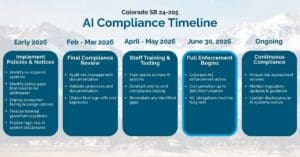
What happens if your business isn’t ready by June 30, 2026
The Colorado Attorney General has enforcement authority. While the law includes a cure period for certain violations, there’s no guarantee regulators will extend that courtesy, and the reputational risk of a public enforcement action is its own cost. More immediately, if a consumer challenges an AI-driven decision and you can’t demonstrate reasonable care, the rebuttable presumption framework works against you.
The window between now and June 30, 2026 feels longer than it is. Impact assessments, vendor audits, and cross-functional governance programs take time to build, especially when you’re working across departments that don’t naturally move at the same pace.
The most effective path forward isn’t trying to solve everything at once. It’s starting with a structured readiness assessment: mapping your AI systems, classifying your risk exposure, and identifying the gaps between where you are and where the law expects you to be. Our AI Advisory team works directly with organizations navigating this kind of regulatory complexity — helping you build compliance that holds up over time, not just on paper.
Frequently asked questions
Colorado’s AI Act (SB 24-205) is a state law that protects consumers from algorithmic discrimination in high-stakes decisions like hiring, lending, healthcare, housing, and insurance. It imposes legal obligations on any business that develops or deploys a “high-risk” AI system and is one of the first laws of its kind in the United States.
The Colorado AI Act takes effect June 30, 2026. The original enforcement date of February 1, 2026 was delayed, but June 30 is the current compliance deadline and should be treated as firm.
The law applies to any organization doing business in Colorado that develops or deploys a high-risk AI system. This includes employers, financial institutions, healthcare companies, insurers, housing platforms, and SaaS vendors whose products make or substantially influence consequential decisions affecting consumers.
A high-risk AI system is one that makes, or substantially influences, a decision with a material effect on a consumer’s access to or cost of education, employment, lending, healthcare, housing, insurance, government services, or legal services. If an AI tool in your tech stack touches any of those categories, it likely qualifies.
A developer builds or substantially modifies an AI system; a deployer uses one in its operations. Many organizations are both, depending on how they’ve customized or integrated the technology, and the distinction matters because each role carries different compliance obligations.
The Colorado Attorney General has authority to enforce the law, and there is no guaranteed right to cure a violation. Beyond legal exposure, a public enforcement action carries significant reputational risk, and organizations that cannot demonstrate reasonable care in an algorithmic discrimination claim are in a weak legal position.
Businesses with fewer than 50 employees may qualify for limited exemptions, such as consumer notification requirements, but only under narrow conditions. The exemption does not eliminate all obligations, and small businesses using AI in consequential decisions should not assume they are fully excluded.
Start with a readiness assessment: inventory your AI systems, identify which qualify as high-risk, determine whether you are acting as a developer, deployer, or both, and conduct impact assessments for each in-scope system. Aligning your governance approach to ISO 42001 or the NIST AI Risk Management Framework is a strong foundation for demonstrating reasonable care.
Yes. If a third-party platform makes or substantially influences a consequential decision, it likely qualifies as a high-risk AI system, and you, as the deployer, carry compliance obligations regardless of whether you built the technology. Vendor documentation gaps are one of the most common compliance challenges organizations face.
Insights By